

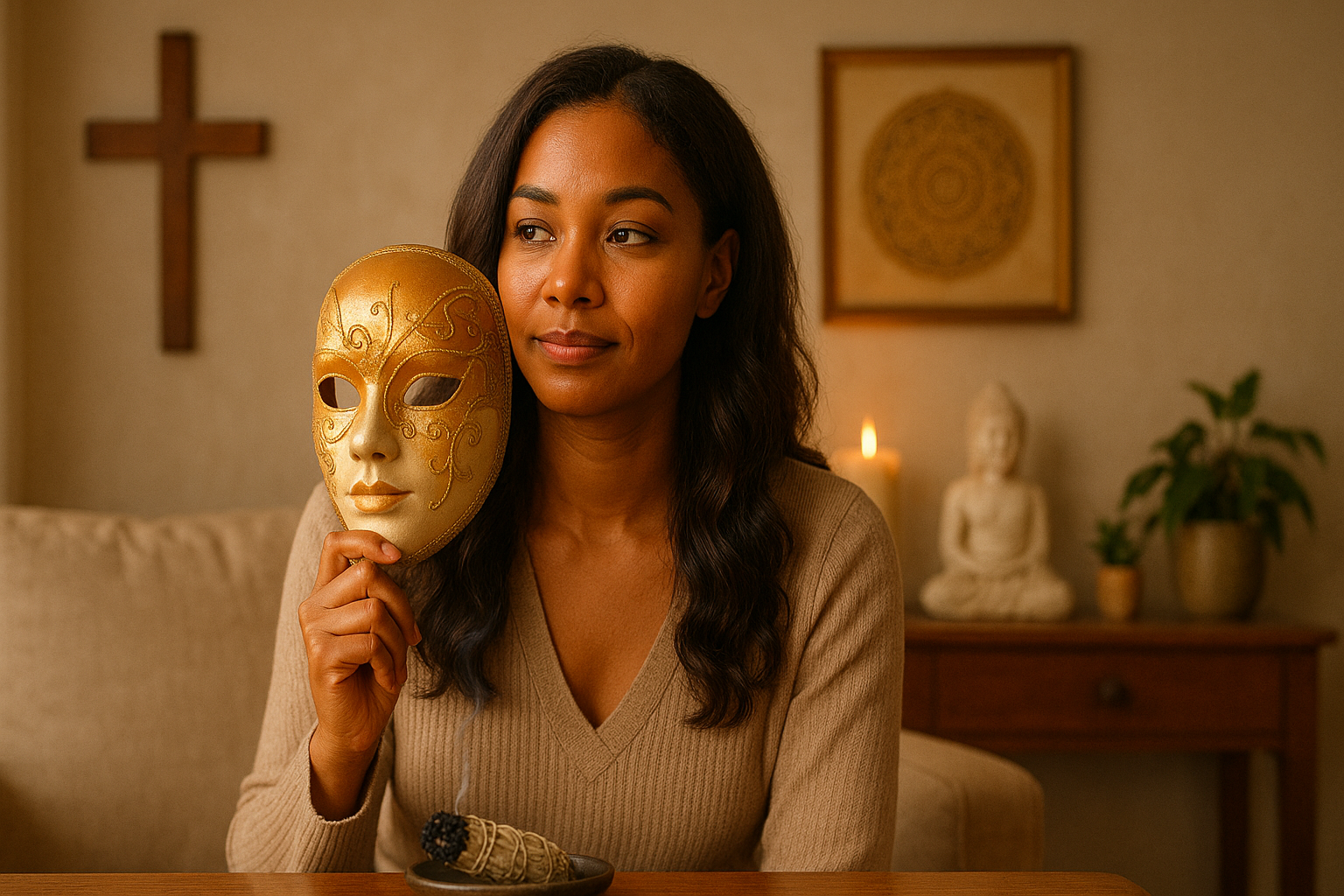
Let’s be real for a minute and talk about spiritual hypocrisy.
There’s a kind of performance happening out here—dressed up in scripture, sage smoke, spiritual lingo, and Sunday bests. Folks quoting the Bible or posting angel numbers, while secretly living lives that contradict every word they preach. They’ll call it “faith.” They’ll call it “light work.” But sometimes? It’s just a mask.
We’ve all seen it—some of us have even worn it. That pressure to look like you’ve got it all together. To appear righteous, wise, woke, chosen. To speak in tongues or manifest with the moon, all while hiding the bitterness, jealousy, control, or pain you don’t want anyone to see.
And let’s be clear: this post isn’t about bashing religion or dragging spiritual folks. It’s not about perfection—nobody is perfect. It’s about honesty and the cost of pretending. Because somewhere along the line, we started performing for each other instead of living in truth.
I believe the only real sin is abandoning your authentic self.
Not because you’re bad—but because when you disconnect from your truth, you cut yourself off from The Divine. From peace. From freedom.
So let’s talk about it. Let’s get uncomfortable if we have to. Because until we start calling this out—not from judgment, but from a place of real love and accountability—we’ll keep confusing image with integrity. And there’s a difference.
What Hypocrisy Looks Like in Spiritual Spaces
Spiritual hypocrisy isn’t always loud. Sometimes, it whispers in hushed tones at the prayer meeting. Baked into a passive-aggressive “bless your heart.” Sometimes, it’s in that look someone gives when they think they’ve already made it to heaven—and you’re still on probation.
Let’s call it what it is: a performance of purity with a spirit of superiority.
In Christian Spaces
Many are raised with this unspoken hierarchy—where the “saved” look down on the “lost,” and grace is only extended to those who sin the right way. If your mistakes fall outside of what’s deemed acceptable in their little bubble of belief, you’re cast out, gossiped about, or told to “get right with God.”
You can quote every scripture and still not know Love.
You can wear a cross but carry a cold heart.
There’s a certain kind of Christian—let’s be honest—that uses religion like a weapon. They speak in tongues, but can’t speak to their own family. Scream about sexual immorality, but stay quiet about abuse in their own churches. They judge folks for dressing “worldly,” while hoarding secret addictions, affairs, and hatred in their hearts. And yet… somehow, they still believe they’re closer to God than the rest of us.
In Spiritual Spaces
And it’s not just limited to Christianity.
In spiritual circles, the same dynamic plays out—with different language.
People chasing “high vibes only,” ignoring real-world problems, preaching love and light while being manipulative behind closed doors. They’ll shame you for not meditating enough, eating clean enough, or not ascending fast enough. Just like some religious folks shame you for not praying enough or dressing holy enough.
In both cases, the goal isn’t connection—it’s control.
It’s not about transformation—it’s about appearing better than someone else.
But here’s the truth: there’s no spiritual trophy for pretending.
And nobody ascends by pretending they don’t have shadows.
The most dangerous part? Hypocrisy hides behind good intentions. People will convince themselves they’re helping you by judging you. That they’re saving you by condemning you. That they’re righteous because they know the rules—even when they’re not living them.
We’ve created communities that reward appearance over authenticity, and it’s costing us real healing. Real connection. Real relationship with The Divine.
Why People Wear the Mask
Nobody wakes up and says, “Today I’m going to be a hypocrite.”
Most of the time, the mask didn’t start out as deception. It started as protection.
For Survival
For a lot of folks—especially in Black and marginalized communities—religion wasn’t just a belief system. It was a survival strategy. During slavery, our ancestors weren’t allowed to express their full humanity, let alone their full spirituality. They had to speak in code. They were taught to fear God in the same breath that they were being beaten in His name. So over time, many learned to perform piety to stay safe—outward holiness became a kind of armor. A way to be accepted, protected, or at least left alone.
And that survival trait got passed down.
Generation after generation, we learned to hide what was real and amplify what was “right.”
Being Good
Even outside of that specific context, most people are handed a very narrow definition of “good.” Especially in religious households, you’re taught early: don’t cuss, be seen and not heard, don’t cry too loud, don’t dress a certain way, don’t express too much. And above all, don’t question God. Follow the rules, even if they don’t make sense. So, what do you do when you’re human? When you mess up? When your desires, your struggles, or your questions don’t fit into the box?
You put on the mask.
It’s fear. Fear of being rejected, cast out, misunderstood. Fear that if people knew the real you, they wouldn’t love you—or worse, they’d try to fix you.
Being Prideful
And let’s be honest—sometimes the mask comes from pride, not fear.
For some, it’s not about hiding their shame. It’s about protecting their image. They’ve built their identity around being “the good one,” the wise one, the anointed one. If that cracks, the whole performance falls apart. So, they hide anything that might make them look weak, messy, or human.
There’s also a deep cultural pressure—especially in communities that have experienced oppression—to represent yourself, your family, and your faith in a certain way. “Don’t let anybody see you slip.” “Keep your business to yourself.” “What happens in this house stays in this house.” That kind of thinking may have helped previous generations survive, but it’s also why so many people today are spiritually suffocating behind smiles and praise dances.
The mask gets passed down. But so does the pain it creates.
And the longer we wear it, the more disconnected we become—not just from others, but from our own truth. We begin to believe the mask is us. That the performance is our personality. That spirituality is about being seen as good instead of being rooted in truth.
But you can’t heal what you hide.
And you can’t be free while pretending to be someone you’re not.
The Spiritual Ego: A Different Kind of Trap
Ego doesn’t always show up loud and brash.
Sometimes it whispers with a smile and floats around quoting scripture or sacred texts.
That’s the thing about the spiritual ego—it’s sneaky.
It convinces you that because you know more, read more, pray more, or meditate more, you are more. More evolved, worthy. More awakened than the rest of the world still “sleeping.”
But honestly: that’s not enlightenment. That’s elitism and arrogance.
It’s a trap because it feels good. It feeds your need to feel important, needed, respected. And who doesn’t want to feel chosen, called, divinely special? But when you start believing your spiritual knowledge makes you better than others, you’ve stopped growing. You’ve just built a higher stage for your performance.
You’ll see it when people talk down to others under the guise of “teaching.”
Or when someone gives unsolicited spiritual advice that’s more about showing off than helping.
You’ll see it when folks call themselves “healers,” “prophets,” “oracles,” “lightworkers,” “pastors,” or “seers”… but use those titles to manipulate, silence, or dominate.
This happens in both religious and “new age” spiritual circles.
In churches, it looks like pastors who weaponize scripture to control people, shame women, or justify oppression. In spiritual spaces, it’s gurus and “guides” who speak of self-love and alignment while secretly abusing their power and dodging accountability.
The spiritual ego is more dangerous than the obvious one—because it hides behind good intentions.
It can even turn self-work into self-worship.
You think you’re “healing” but really you’re just crafting a more polished mask.
You say “I’m protecting my peace,” but really you’re just avoiding hard truths.
Saying “I don’t entertain low vibrations,” but really you’re afraid of being seen without the costume on.
And let’s be honest—we’ve all had moments where we’ve slipped into this.
It’s human. But staying there? That’s a choice.
True spirituality isn’t about hierarchy.
It’s not about showing how “unbothered,” “anointed,” or “activated” you are.
It’s about how deeply you’re willing to face yourself. Love yourself. Be honest with yourself.
The goal isn’t to be above others.
The goal is to be so real with yourself that ego has nothing left to prove.
The Real Consequences of Hypocrisy
Spiritual hypocrisy isn’t just annoying.
It’s not just a personality flaw or a petty habit.
It’s destructive—to the individual, to the community, and to the soul.
Internal Damage
When you perform righteousness but live disconnected from your truth, you start to rot from the inside. That sounds harsh, but it’s real. There’s a slow erosion of integrity. And integrity isn’t about morals—it’s about wholeness. About not living split in two.
Pretending to be holy while secretly battling demons you won’t name doesn’t bring you closer to God—it creates a wall between you and divine connection.
You’re saying the right things, but your heart is hollow. Your spirit feels off. You can’t quite hear Spirit clearly, and your peace feels fake. That’s not punishment. That’s your soul trying to get your attention.
Relational Consequences
People feel when you’re not being authentic. Even if they can’t put it into words, they feel the energy. The disconnect. The power-plays. The passive aggression wrapped in scripture. The way you make them feel small while calling it “love.”
And eventually? They stop trusting you.
This is why so many are leaving churches, avoiding spiritual communities, or choosing solitude over fellowship. Not because they don’t believe in God—but because they’re tired of being hurt by people who say they do.
Generational Fallout
When hypocrisy is modeled as holiness, it breeds confusion in children and spiritual resentment in adults. People raised in these environments often:
- Abandon faith altogether.
- Struggle with identity and shame.
- Develop perfectionism or people-pleasing.
- Pass on the same mask to their own kids.
It becomes a legacy of spiritual distortion. One that tells you your worth is in how well you hide your flaws.
Collective Damage
When communities uplift image over truth, abusers go unaccountable, harm is buried, and healing is delayed—if it happens at all. Entire movements fall apart because they were built on charisma, not character. On theatrics, not truth.
And let’s not pretend God isn’t watching all of it.
You can fool people. You can curate a whole aesthetic.
But you can’t fool The Divine.
You can’t fake alignment or “manifest” your way around your own shadows.
You either live in truth, or you perform in fear.
Religion vs. Relationship (with Self and The Divine)
Religion can give you a blueprint.
But relationship? That’s what brings it to life.
The truth is, you can follow every rule and still be lost. You can attend every service, burn every candle, memorize every verse—and still not know peace. Still not know yourself. Still not feel connected to anything greater than your own guilt.
Because religion, without relationship, becomes routine.
It becomes performance.
It becomes fear disguised as faith.
Intimacy With God
What nobody tells you is that God, The Divine—whatever name you speak in love—wants your truth, not your costume. Wants your honesty, not your spiritual resume. Wants your tears, your anger, your joy, your confusion. The raw and unedited you.
That’s relationship. That’s intimacy.
And that can’t exist when you’re more committed to appearing good than being true to yourself.
Some of us were raised to believe God is more interested in obedience than authenticity. That if you “act right,” you’ll be accepted. But real relationship with The Divine is not transactional—it’s transformational. You don’t have to earn it. You live it. By showing up in your truth, over and over again.
Relationship With Self
And here’s the twist: your relationship with God reflects your relationship with yourself.
If you’re harsh, judgmental, and fearful with yourself… that’s likely how you see God too.
When you’re disconnected from your own truth, it’s hard to discern divine truth.
If you think love must be earned, then grace will always feel like a loophole—not a birthright.
That’s why so many spiritual people struggle with shame.
Why so many religious people feel hollow.
They’ve never been taught how to be with themselves—only how to manage themselves into acceptability.
But your soul doesn’t want to be managed. It wants to be known.
It wants a relationship, not a religion.
To feel free in the presence of The Divine, not perform for it.
This is where healing begins—when you stop trying to be “good” and start choosing to be whole. When you move from fear-based rule-following to soul-based truth-living. When you realize that The Divine meets you in your realness, not in your mask.
Living Authentically—The Only Rule That Matters
If there’s one spiritual rule worth following, it’s this:
Be real, in all that you do.
Not perfect, polished, or performative. Just… real.
We’ve been taught that holiness is about getting everything “right”—but what if it’s actually about being whole?
Being aligned, honest. Being free from the inner war of who you are versus who you pretend to be.
Living authentically is the rule that sets every other part of your life in motion.
When you’re honest with yourself:
- You stop tolerating what drains you.
- You draw in people who love the real you.
- You feel peace in your body, because you’re not at war with your truth.
Authenticity doesn’t mean you always get it right. It means you’re not hiding.
You don’t shrink your truth to be accepted.
It means you don’t dress up your soul just to make someone else comfortable.
Divine Alignment
And here’s the wild thing: you can be messy, unsure, raw—and still be divinely aligned.
The Divine isn’t scared of your shadow. God isn’t keeping score of your slips. Man does that. What does block your blessings is pretending you’re fine when you’re not. Lying to yourself and others to preserve an image. Calling it “faith” when it’s really fear of being fully seen.
This kind of truth-telling is rebellious in a world that profits from our pretending.
But authenticity? That’s sacred, spiritual, and where healing happens.
When you stop reciting what you were taught and start living what you know deep in your bones—that you are worthy, even in your rawest form.
So, forget performing. Forget pleasing. Forget trying to be “good enough.”
If you’re going to follow one rule, let it be this:
Live as your full self—even if it makes people uncomfortable.
Even if it costs you admiration. Even if you must let go of every identity you use to hide behind.
Because truth is the only thing that sets you free. And freedom? That’s where God lives.
A Mirror Check, Not a Finger Point
Let’s be clear—this isn’t about dragging folks who are trying to find their way.
It’s about taking the mask off ourselves first.
It’s easy to spot hypocrisy in others. Easy to roll your eyes at the folks preaching one thing and doing another. But this ain’t just about them. This is about us.
The ways we perform. The ways we shrink. The parts of ourselves we silence just to be liked, praised, or seen as “good.”
Because we’ve all worn the mask at some point.
Some of us are still wearing it, even now, even quietly.
Not because we’re fake. But because we were taught that truth would cost us too much.
And maybe it will.
Maybe people will walk away when you stop performing.
Maybe you’ll lose status, relationships, or comfort.
But what you gain is worth more: peace, clarity, freedom, and a connection to The Divine that doesn’t require rehearsal.
This is your invitation to hold up a mirror—with compassion, not criticism.
Ask yourself:
- What version of myself do I perform for others?
- What truth about me am I afraid to let people see?
- Where am I still choosing image over alignment?
- Am I hiding behind my beliefs to avoid doing the deeper work?
- Is my spiritual practice helping me be more honest, or just more impressive?
And then—give yourself grace. Because this isn’t about shame. It’s about shedding.
We don’t grow by pretending we’ve arrived.
We grow by being willing to start again—in truth, in presence, in full view of who we really are.
Final Reflection: From Performance to Freedom
You can keep performing, or you can be free.
But you can’t do both.
That’s the bottom line of all of this.
Wearing the mask might get you applause, affirmation, even power. But it won’t give you peace. It won’t connect you to Spirit in a real, sustaining way. It won’t heal what’s still bleeding beneath the surface.
This post wasn’t written to shame anybody—it was written as a reminder. For me, you, and anyone tired of the show. Because the truth is, the pressure to be perfect didn’t come from God. It came from fear. From people, tradition, and trauma.
But you’re allowed to put that pressure down now.
You’re allowed to be real, raw, in-process, unfinished—and still worthy of love, grace, and divine connection. You’re allowed to stop hiding, to question what you were taught if it keeps you in chains.
We’ve explored a lot—the cost of hypocrisy, the trap of the spiritual ego, the roots of the mask, and the freedom of truth. It all leads here—to this truth:
God doesn’t want your performance. God wants your presence.
Your realness. Your questions. Your joy and your grief. Your full, whole self.
You don’t have to keep proving you’re “good.” You just have to show up in truth.
Because the only sin is abandoning who you really are to become who others expect you to be.
That’s not holiness. That’s imprisonment.
And you were made for more than that.
Call to Action
So here’s your invitation:
Drop the mask.
Sit with yourself—no filter, no fluff.
Ask the hard questions. Be honest about the parts you’ve hidden, even from yourself.
And then?
Start living in a way that feels real. That feels rooted. That feels like you.
Because once you taste the freedom that comes from truth, you won’t ever want to go back to pretending.
And if this post stirred something in you—good. That means the real you is waking up. Welcome her home.

Share your thoughts…respectfully of course.